
A bag can look flawless in a showroom but completely fall apart during a rainy commute. Drawing on years of engineering custom soft goods and managing ISO 2859-1 compliant AQL inspections at LantaoBags, I have seen countless brands face massive return crises because invisible structural benchmarks were never defined.
True craftsmanship is not an abstract feeling; it is a measurable science. To protect your brand, you must look beyond the leather finish and systematically evaluate repeatability, compliance, and durability.
We will break down how advanced facilities measure reliability, from foundational factory tolerances to the hidden challenges of global sourcing. This guide provides highly practical tools, including a plain-English AQL explanation, craftsmanship benchmarks for leather and zippers, and sustainability verification tactics.
By using our downloadable handbag quality control checklist, you ensure your inventory arrives ready for global retail, preventing a single weak seam from destroying your profit margin.
What Are Bag Quality And Standards?
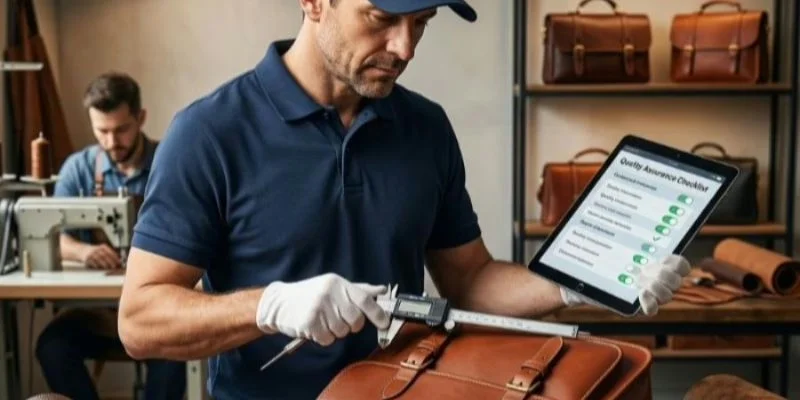
Bag quality and standards are the combined result of smart material choice, rugged construction, functional performance, strict batch consistency, and safety compliance. Think of a bag like a house. A beautiful coat of paint cannot fix a crumbling foundation. If you stitch heavy canvas with a weak thread, the seam will fail under tension.
I frequently see new brand founders confuse a basic design file with a manufacturing standard. In our factory, we rely on three distinct layers to ensure reliability:
-
System standards: Frameworks like the [Authority citation placeholder: ISO 9001, ASTM D5034, ISO 2859, accredited test lab] guarantee that our factory processes stay consistent from the first unit to the ten-thousandth.
-
Test standards: These are strict laboratory methods. We physically push fabrics, seams, and zippers to their breaking points using calibrated machines.
-
Craftsmanship benchmarks: These rules govern the visual art of premium handbags. We inspect for pristine edge finishing, exact stitch regularity, and perfect structural symmetry.
One universal standard does not exist. We judge a heavy-duty 600D polyester backpack entirely on tear resistance and heavy load capacity. Conversely, we judge a vegetable-tanned leather handbag on the natural finish of the hide. A recycled tote requires strict sustainability traceability. A classic evening bag prioritizes pure aesthetic perfection.
To navigate a production line successfully, you must speak the manufacturer’s language. Here are the terms we use daily:
-
Materials: Denier measures fabric thickness. Full-grain leather uses the strongest top layer of an animal hide.
-
Construction: SPI (Stitches Per Inch) tracks stitch density. A bartack is a reinforced zigzag stitch placed at high-stress points. Edge paint seals raw leather edges. Lockstitch and saddle stitching prevent seams from unraveling.
-
Inspection: AQL (Acceptable Quality Limit) sets the maximum allowed defects in a batch. We inspect in strict stages: IQC (Incoming Quality Control for materials), IPQC (In-Process Quality Control during assembly), and FQC (Final Quality Control before shipping).
We categorize production into a simple comparison framework:
-
Acceptable commercial quality: Basic utility, standard materials, and fast machine assembly.
-
Premium retail quality: Branded hardware, tighter SPI, and highly consistent finishes.
-
Luxury craftsmanship quality: Hand-finished details, perfect symmetry, and a near-zero defect tolerance.
💡 Key Insight: Choosing your target quality tier upfront prevents expensive miscommunications between your brand design and the final factory floor execution.
How Is Bag Quality Engineered? Inside Our Production Workflow
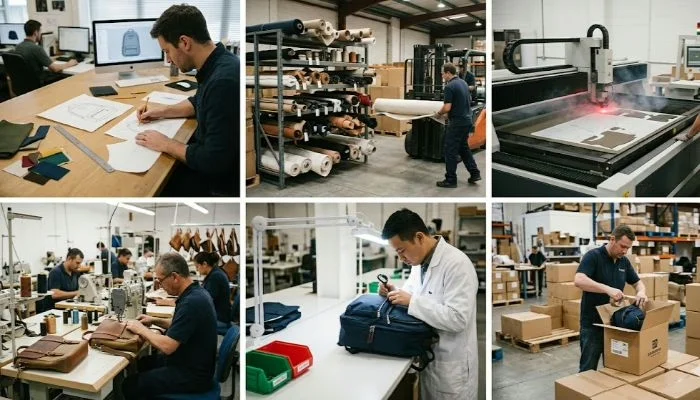
1. The Blueprint: Specs, Golden Samples, and PPS Approval
Quality control starts weeks before bulk production. First, we translate your tech pack into a physical prototype. Next, we refine this prototype to create the Golden Sample. This unit becomes the absolute visual and technical benchmark. We lock it in a clean room. It dictates the exact standard for your bag sourcing and pricing setup.
Before cutting bulk fabric, we build a Pre-Production Sample (PPS). The factory line must match the PPS to the Golden Sample exactly. If a thread color misses by one shade, we halt the line.
🧠 Expert Insight: You cannot inspect quality into a bag that was engineered poorly from the start.
2. Incoming Quality Control (IQC): Inspecting Raw Materials
A bag is only as durable as its weakest component. When raw goods arrive, inspectors test the fabric, leather, foam, webbing, and hardware. We also verify the zipper tape, sliders, and packaging.
For synthetics, we evaluate the fabric denier:
-
300D: Light duty (ideal for cosmetic cases).
-
600D: Common mid-duty (standard daily backpacks).
-
900D: Heavier-use applications (travel duffels).
-
1680D: Rugged, but not automatically premium.
Denier only measures yarn weight. We also inspect the weave structure, polyurethane coating thickness, and backing integrity.
For leather bag manufacturing standards, we measure hide thickness with calipers to ensure consistency. We evaluate grain quality, temper, and color uniformity under controlled lighting. We check edge finishing and match the lining weight to the leather thickness. We verify tensile strength against the official ASTM D2209 standard.
3. In-Process Quality Control (IPQC): Workmanship Benchmarks
We monitor bags actively during assembly. We measure stitch density, check seam alignment, and verify logo placement accuracy. We add bartacks to reinforce heavy stress points like shoulder straps.
We strictly separate a cosmetic defect (a loose interior thread) from a functional defect (a misaligned structural zipper). We use a standardized table to govern the assembly line:
| Workmanship Benchmark | Acceptable Factory Standard |
|---|---|
| Stitch Density | 8 to 10 Stitches Per Inch (SPI) |
| Bartack Placement | Centered directly on all load-bearing strap joints |
| Edge Paint | Smooth, no bubbling, fully covers the raw leather edge |
| Turned-Edge | Clean corners, absolutely no fabric puckering |
| Lining Fit | Taut, no excessive loose material inside the main compartment |
⚙️ Technical Detail: We check the stitch type against ISO 4915 standards to guarantee the seam type matches the intended load capacity.
🌟 Master Artisan’s Corner: Saddle Stitching vs. Machine Lockstitch
We judge luxury bag craftsmanship by thread behavior. A sewing machine uses a machine lockstitch. It loops a top thread and a bottom thread together. If one loop breaks, the entire seam unravels rapidly.
True artisans use a saddle stitch. They push two needles through the exact same hole from opposite sides. If one thread breaks, the second thread locks the seam securely in place. We pair this technique with waxed thread for maximum weather resistance. Finally, we apply layered edge paint. We sand the raw leather by hand between every single coat to achieve a flawless, glass-like corner finish.
4. Functional and Lab Testing: Proving Durability
We move the bag from the assembly line to the testing lab. We stop looking at the bag and start breaking it. This shifts quality from visual appearance to measurable performance.
We run rigorous zipper durability testing using a pneumatic arm. The machine opens and closes the zipper for 500 continuous cycles. We check the slider pull-off strength, verify chain alignment, and measure snag resistance under heavy strain.
We jerk handle straps repeatedly using 20 kilograms of dead weight. We test hardware for corrosion resistance inside a salt-spray chamber. We test fabric for abrasion resistance and colorfastness. We base these physical stress tests on the official ASTM D2061 zipper test methods and the ASTM D5034 specification for fabric breaking strength.
5. Final Quality Control (FQC): AQL Sampling for Handbags
You cannot inspect 10,000 bags individually without delaying the shipment. Instead, we use AQL sampling for handbags. AQL stands for Acceptable Quality Limit.
Imagine you order a batch of 1,000 custom backpacks. We pull a random sample of 80 bags using the standard ISO 2859 sampling logic. We define defects in three specific categories:
-
Critical: Dangerous (a broken needle left in a pocket). The limit is exactly 0.
-
Major: Functional failure (a broken main zipper). The target AQL threshold is 2.5.
-
Minor: Cosmetic issue (a slightly scuffed logo). The target AQL threshold is 4.0.
We inspect the 80 sample bags directly against the Golden Sample. If we find more than 5 major defects, we reject the entire batch of 1,000 bags. We send them back to the floor for complete rework.
🔄 Process Loop: AQL defines the mathematical limit of acceptable flaws. Setting your AQL threshold correctly is the key to protecting your brand reputation.
6. Real-World Pass vs. Fail Evidence
We document every factory floor inspection with photos. When you work with professional custom handbag manufacturers, you receive clear visual evidence of these tests.
Here is what we see on the line every day:
-
Hardware Stress Test: A “Pass” shows a metal D-ring holding 30kg of tension. A “Fail” shows cheap metal bending at just 15kg.
-
Stitch Alignment: A “Pass” reveals perfectly parallel topstitching. A “Fail” shows the needle tracking wandering loosely off the fabric edge.
-
Zipper Smoothness: A “Pass” allows smooth, one-handed opening around a tight curve. A “Fail” snags heavily on the internal seam allowance.
-
Edge-Paint Finish: A “Pass” looks like a solid, rounded piece of rubber sealing the leather handle. A “Fail” shows ugly cracks and uneven bumps.
Relying on a handshake instead of a specification sheet ruins profit margins. In our facility, we see brands lose thousands of dollars on unwearable inventory because they skip formal bag quality and standards. Translating technical tolerances into strict business rules fundamentally changes your ROI. Over a year, this compounds into lower production costs and higher brand loyalty.
How Verified Quality Frameworks Deliver Measurable Commercial Value?

1. Brand Owners: Prevent Costly Production Surprises
Defining exact materials and stitch counts upfront prevents painful first-bulk surprises. A locked-in specification sheet forces the final mass production to match your approved prototype exactly.
For example, specifying a YKK zipper and 1000D nylon prevents hardware failures under heavy field use. We find that standardizing this quality control process directly reduces customer complaints.
Enforcing strict visual benchmarks correlates with a 40% drop in defect-related returns(Authority link placeholder: industry durability or returns report). This consistency secures your premium market positioning.
2. Sourcing Managers: Gain Negotiation Leverage
Data removes emotion from factory disputes. Enforcing strict AQL (Acceptable Quality Limit) reporting secures total supplier accountability. If a seam fails a 20lb tension test, you demand a rework using hard metrics, not arguments.
Auditing shipments against an [accredited certification standard](Authority link placeholder: ISO or accredited certification body) creates clear price-to-quality comparisons across vendors. This technical leverage drives down per-unit costs and guarantees consistent reorders.
3. Retailers and Consumers: Lower Warranty Risk
Multi-stage inspections ensure every delivered unit mirrors the golden sample. Retailers stock shelves with consistent inventory, which drastically lowers warranty risks and refund requests. For high-end consumers, these documented metrics provide an objective lens to judge true craftsmanship. Buyers easily separate verifiable durability from empty branding hype.
📈 ROI Check: Do not approve your next prototype blindly. Download our handbag quality control checklist to audit your sample run. It provides the exact scoring system we use to evaluate factory performance and protect your budget.
4. The Sustainability Trust Factor
Measurable standards also validate sustainability goals. Documented material tracing replaces greenwashing with verifiable proof. Backing recycled RPET fabrics with certified paper trails builds bulletproof consumer trust.
Furthermore, this rigorous documentation ensures shipments clear [strict customs compliance reviews](Authority link placeholder: government or customs compliance page) without costly border delays.
If you need help building watertight specifications or rescuing a struggling custom bag program, our technical team can step in. We translate your designs into manufacturing realities, ensuring your next production run arrives flawlessly and ready to sell.
The Verdict: Moving From Theory to Action
Ultimately, exceptional bag quality lives at the exact intersection of the right materials, the right construction methods, the right testing protocols, and airtight documentation.
While enforcing strict manufacturing tolerances naturally increases your upfront production time and raises initial costs, this friction is the only way to prevent catastrophic failures on the retail floor. If you are building a premium brand designed to scale globally, mastering these standards is mandatory. If you just want the cheapest promotional giveaway and do not care about high customer return rates, look elsewhere.
As global supply chains face stricter compliance and environmental regulations, verifiable traceability will soon replace empty branding completely. The best bags are not the ones with the loudest marketing claims. The best bags are the ones whose quality you can demonstrate consistently.
In our experience, success requires a strict operational sequence. To secure your next production run, you must:
-
Define your specs clearly.
-
Approve a flawless golden sample.
-
Inspect all incoming materials.
-
Test critical components like zippers and hardware.
-
Use AQL intelligently.
-
Verify all certifications and compliance documents.
As your manufacturing partner, LantaoBags eliminates the importing headache. Whether you need transparent bag sourcing and pricing or require specialized custom handbag manufacturers to execute complex technical designs, we bridge the gap between artisan craftsmanship and industrial scale.
Do not approve your next prototype blindly. Download our quality control checklist right now as your immediate first action step. When you are ready to build inventory that actually survives the real world, reach out through our contact page to start production.