
When founders submit tech packs with just basic length and width, I expect production delays. A consumer approach to bag measurements and sizing fails on the factory floor.
Mixing flat dimensions with packed volume causes sample disputes and ruins freight estimates. This guide outlines our 15-minute factory workflow. We separate measuring from data interpretation to capture accurate dimensions, volume estimates, and clear gusset logic.
This B2B standard prevents the costly dimensional weight penalties set by the International Air Transport Association (IATA).
Author’s Verdict: Separating flat dimensions from internal volume prevents 90% of sampling errors and ensures clean e-commerce listings.
You will finish with a factory-ready record and fewer sample revisions. Download the PDF Bag Spec Sheet below for standard manufacturing tolerances.
Technical Specifications: Dimensional Analysis & Volume Calculation
Precision in measurement is key for manufacturing and logistics. This five‑step protocol offers a clear framework for measuring a tote bag, calculating its capacity, and finalizing technical documentation.
Step 1: Establish Your Physical State

In our prototyping runs, inconsistent bag measurements and sizing cause the most factory disputes. Establish a strict baseline.
Tool Checklist:
-
Flexible tape measure: For soft curves and strap lengths.
-
Rigid ruler: I require this to check structured edges and gussets.
-
Flat table: Hard surfaces only. Couches warp your baseline.
-
Camera or phone: Photograph exact reference points.
-
Documentation: Use a notebook, spreadsheet, or download our PDF Bag Spec Sheet.
Factory Rules:
-
State Alignment: Measure the bag empty, lightly shaped, fully expanded, or packed. Mixing states ruins specs.
-
Measurement Order: Write dimensions as Width (W) x Depth/Gusset (D) x Height (H). Note handle drop or strap length separately.
-
Metric-First: Record in centimeters. Convert to inches for US buyers later.
-
Accessibility: Describe measurement points in words. Never rely solely on colored arrows.
-
Compliance: For luggage, external dimensions must include all protrusions (wheels, handles, feet, piping, front pockets).
-
Volume Standards: Follow Official ASTM backpack volumetric testing guidelines.
🧠 Expert Take: Textile manufacturing is not CNC machining. I plan for a default tolerance of +/- 1cm. For tighter fits, secure a written factory agreement before sampling.
In our prototyping runs, a soft canvas tote collapses inward while a framed backpack stands on its own. This physical behavior dictates your bag measurements and sizing approach.
-
Place the bag on a hard, flat table.
-
Remove all internal stuffing unless you are intentionally measuring packed dimensions.
-
Choose one measuring state before pulling out a tape measure:
Flat-laid: Select for most soft bags and 2D pattern comparisons.
-
Fully expanded: Select for finished product specifications and everyday-use size claims.
-
Packed dimensions: Select for luggage compliance, freight estimates, or Amazon FBA size tiers.
-
Smooth the body fabric of curved or slouchy bags naturally. Do not stretch the material to inflate the measurement.
-
Photograph the bag from the front and side.
-
Label the exact Top Edge, Base Edge, and Side Seam in plain text on your specification sheet for screen-reader and colorblind accessibility.
Once your physical state is fixed, measure the core dimensions without guessing.
Step 2: Measure The Core Body And Handles
In our factory tests, a sagging tape ruins measurement accuracy. Measure the finished bag externally to establish baseline bag measurements and sizing.
-
Measure the width. Pull your tape taut across the Front Panel at the widest usable point. Explicitly exclude the side gussets.
-
Measure the height. Run the tape straight from the Top Opening Edge to the lowest point of the Base. For backpacks, state whether this figure includes top grab handles.
-
Measure the handle drop. Lift the straps to form a natural arc. Measure from the highest peak down to the Top Opening Edge. ⚠️ Warning: A twisted strap falsely shortens the drop length. Keep materials perfectly flat.
-
Record adjustable lengths. Measure the total strap length separately for adjustable crossbody styles.
-
Write accessible specs. Use descriptive text like “front panel width” instead of “measure the green line.” Avoid visual-only instructions to meet the official Web Content Accessibility Guidelines.
Bag variations matter. Handbags emphasize drop and internal opening width. Backpacks require torso-facing height, strap length range, and laptop sleeve dimensions.
🔍 Troubleshooting: Measure twice from both sides on symmetrical bags. I use this checkpoint to catch skewed handle placements before mass production.
Step 2: Measure The Core Body And Handles
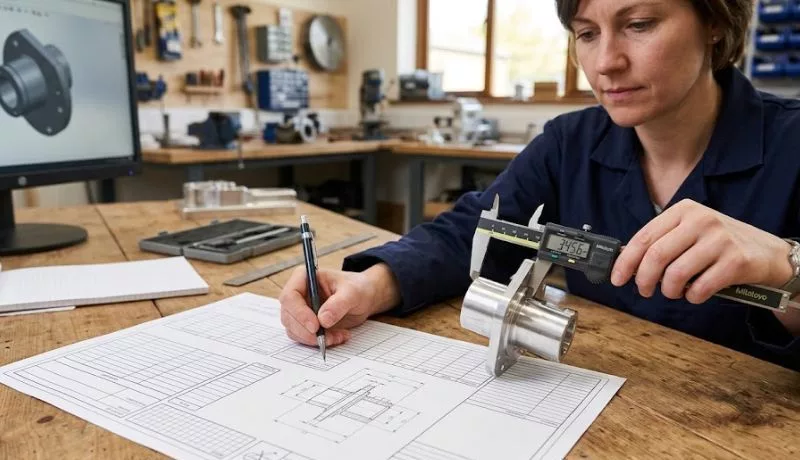
Create a final measurement table to ensure two people measuring the same seam get identical results. Download our PDF Bag Spec Sheet template to see the required formatting in action.
Build your table with these exact columns: Point of Measure, Method/Where to Measure, External or Internal, Unit, Target Size, Tolerance, and Notes.
Insert photos or technical flats directly into the document. Draw clear arrows for every non-obvious point of measure. State your trust benchmark directly inside the file. Write ”+/- 1cm unless otherwise agreed” to prevent baseline disputes.
If you order in bulk, add a master carton section. Include flat-packed dimensions and shipping notes for accurate import planning. Understanding how measurements affect quoting is critical for your budget. Proper bag measurements and sizing dictate your final freight costs.
Small sellers can use a simplified listing-only chart for e-commerce. However, a prototype handoff or factory collaboration always requires the full, detailed version.
Pro Tips from the Factory Floor: Thick materials, foam padding, piping, and binding change internal measurements after assembly. Always account for this volume loss in your spec sheet notes.
Troubleshooting

Use the following guide to identify and resolve discrepancies between design specifications and production output, ensuring consistent quality and logistical compliance.
Problem 1: “My Sample Dimensions Do Not Match The Factory.”
We see this constantly in prototyping. You measured the flat external shell. The factory measured the packed internal space.
-
Confirm both sides used the exact same bag state.
-
Check your tech pack for default tolerance limits.
💡 Diagnostic: Require vendor photos showing the measuring tape laid directly on the physical sample.
Problem 2: “The Bag Depth Looks Wrong In Production.”
This happens when boxed-corner math gets lost between the flat pattern and final quality checks.
-
Verify your specific gusset type.
-
Measure the depth across the true flat base. Do not measure folded side seams.
Founders often panic over shallow flat samples. Pack the bag fully to confirm the true volume.
Problem 3: “The Bag Fails Shipping Limits.”
You likely based logistics math on internal capacity. Couriers only care about the maximum external envelope.
-
Pack the bag to absolute maximum capacity.
-
Measure the widest external points.
-
Include rigid wheels, handles, and bulging pockets.
Verify final dimensions against official IATA baggage guidelines to avoid heavy oversized shipping penalties.
Problem 4: “Customers Complain About The Size.”
Buyers rarely understand fabric stretch. Set clear expectations to protect your margins.
-
Publish bag measurements and sizing in both centimeters and inches.
-
Label internal versus external measurements clearly.
-
Add a short textile tolerance note.
Conclusion
Based on our review of hundreds of factory tech packs and thousands of hours on the production floor, we know that consistent data prevents costly errors. You now have a repeatable process to measure bag dimensions, depth, gussets, internal space, and estimated capacity.
However, the true value is not the tape measure itself. The real power lies in building a clear final spec sheet. Your immediate next action is to download our PDF Bag Spec Sheet template.
Fill it out for one existing sample. Use this document as the single source of truth for your brand and your custom handbag manufacturers.
Whether you are exploring bag sourcing and pricing or scaling global logistics with LantaoBags, accurate measurements protect your profit margins. Ready to start production? Send your completed spec sheet or sample inquiry directly to our team here.
People Also Ask About Bag Measurements And Sizing
1. Does a bag’s depth include the front pocket?
Yes, external depth includes the front pocket. When we quote freight costs, shipping couriers always measure the widest extreme points.
If your design has a bulging 3-centimeter front pocket, add that to your total depth. I have seen clients face heavy oversized shipping fees because they only measured the main side gusset.
2. What is the standard manufacturing tolerance for soft bags?
The industry standard tolerance is +/- 1cm for most soft goods. In our factory runs, pliable fabrics like canvas naturally shrink and stretch during the sewing process.
If you need a tighter fit for a rigid laptop sleeve, you must request a specific zero-tolerance mold. Always write your acceptable tolerance directly on your tech pack.
3. How do you calculate the liter capacity of a backpack?
You calculate capacity by multiplying the internal width, depth, and height in centimeters, then dividing the total by 1,000. However, I found this box formula overestimates curved bags by up to 20%.
For precise volumes, our team uses physical testing beads following the official ASTM F2153 standard to measure true liter capacity.